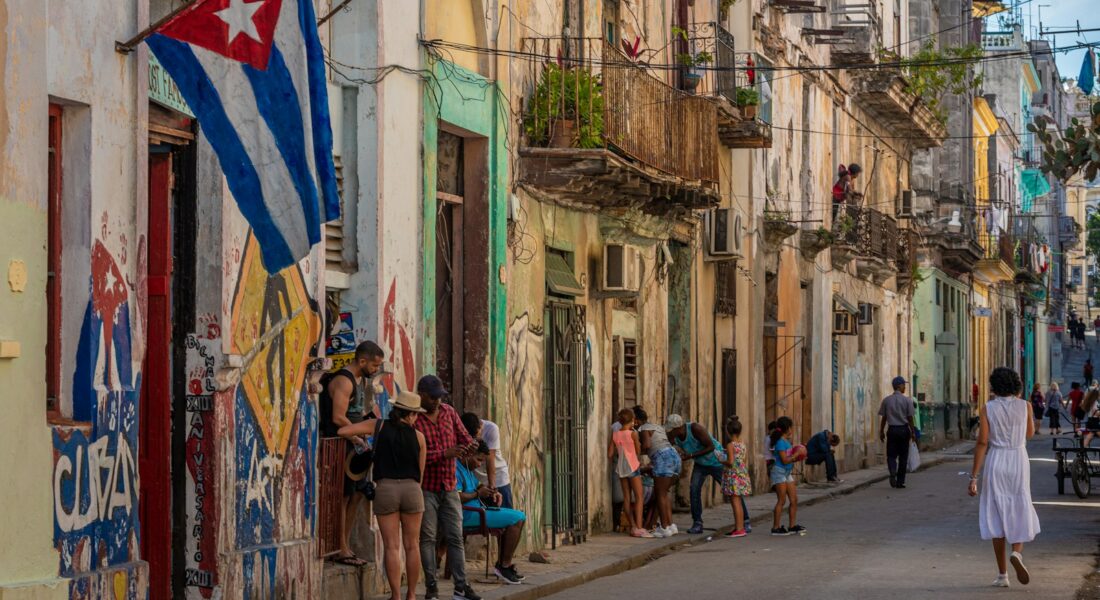
President Donald Trump signed an executive order on May 1, 2026, broadening U.S. sanctions against the Cuban government under the International Emergency Economic Powers Act (IEEPA), 50 U.S.C. §§ 1701 et seq. [1][2] The order, formally titled "Imposing Sanctions on Those Responsible for Repression in Cuba and for Threats to United States National Security and Foreign Policy," extends the national emergency first declared in Executive Order 14380 on Jan. 29, 2026, which designated Cuba an "unusual and extraordinary threat" to U.S. national security and foreign policy. [3][4] The new order does not name specific individuals or entities; designations will be made at the discretion of the Secretary of State, in coordination with the Secretary of the Treasury, without advance notice to targeted parties. [5][6]
**Sanctionable Conduct**
The order imposes new sanctions on entities, persons, or affiliates that support the Cuban regime's security apparatus, are complicit in government corruption or serious human rights violations, or are agents, officials, or material supporters of the Cuban government.[1][2] It freezes all U.S.-sited assets of foreign individuals operating in Cuba's energy, defense, metals and mining, financial services, and security sectors, and applies to leaders, officials, or executives of the Cuban government, those providing material support to the regime, and those responsible for severe human rights abuses or corruption.[7] Notably, the order extends sanctions to "any adult family member of a person designated under this order," broadening the reach beyond direct officials.[5] The order states that targeted individuals will not receive advance notice before designation, on the grounds that prior notification would allow rapid asset transfers that would render the measures ineffective.[5]
**Secondary Sanctions and Foreign Bank Exposure**
The order also imposes secondary sanctions on people, entities, and financial institutions that conduct financial transactions with those already sanctioned for ties to Cuba, authorizing the U.S. government to penalize foreign financial institutions that have "conducted or facilitated any significant transaction or transactions for or on behalf" of anyone with such ties.[8] As one sanctions practitioner noted, "Oil and gas, mining companies, and banks that have carefully segregated their Cuba operations from the United States are no longer protected."[4] Compliance teams at foreign financial institutions with any Cuba-related exposure should reassess the adequacy of their current screening programs in light of this expanded secondary liability.
**Legal Framework and Procedural Posture**
The order invokes presidential authority under IEEPA (50 U.S.C. 1701 et seq.), the National Emergencies Act (50 U.S.C. 1601 et seq.), section 212(f) of the Immigration and Nationality Act of 1952 (8 U.S.C. 1182(f)), and section 301 of title 3 of the United States Code, and expressly builds on the national emergency declared in Executive Order 14380 of Jan. 29, 2026.[3] The shift toward asset freezes represents a departure from the January 2026 tariff-based approach, from which Trump retreated after a court ruling found the oil tariff mechanism illegal under IEEPA. Asset freezes are a more traditional use of IEEPA authority and present a narrower litigation target.[5] The president's authority to impose tariffs under IEEPA remains under judicial review by the U.S. Supreme Court.[9]
**Policy Arc**
Friday's order is the latest in an escalating pressure campaign. In June 2025, Trump strengthened Cuba policy through a National Security Presidential Memorandum, conditioning U.S.-Cuba engagement on human rights progress, private-sector development independent of government control, and national security objectives.[1] In January 2026, a separate executive order declared a national emergency and established a tariff framework targeting third-country oil suppliers to Cuba.[1] Trump threatened punishing tariffs on any country sending crude to Cuba, prompting Mexico to halt shipments, and the resulting fuel shortage has contributed to major blackouts and prompted numerous foreign airlines to suspend flights to the island.[4] The State Department sent a delegation to Cuba in April to discuss a deal addressing the humanitarian crisis,[8] stressing that time was running out for Havana "to make key U.S.-backed reforms before circumstances irreversibly worsen."[10] Earlier this week, the Senate blocked a resolution designed to require congressional approval before the president could initiate military action against Cuba.[11] Cuba's Foreign Minister Bruno Rodríguez characterized the new measures as "unilateral coercive measures" that violate the United Nations Charter.[4]
—
—
References:
[1] White House. (2026, May 1). Fact Sheet: President Donald J. Trump Imposes Sanctions on Cuban Regime Officials Responsible for Repression and Threats to U.S. National Security and Foreign Policy. https://www.whitehouse.gov/fact-sheets/2026/05/fact-sheet-president-donald-j-trump-imposes-sanctions-on-cuban-regime-officials-responsible-for-repression-and-threats-to-u-s-national-security-and-foreign-policy/ [2] CBS News Miami. (2026, May 1). Trump's executive order tightening U.S. sanctions on Cuba is a warning to other countries, expert says. https://www.cbsnews.com/miami/news/trump-executive-order-tightening-u-s-sanctions-on-cuba/ [3] White House. (2026, May 1). Imposing Sanctions on Those Responsible for Repression in Cuba and for Threats to United States National Security and Foreign Policy. https://www.whitehouse.gov/presidential-actions/2026/05/imposing-sanctions-on-those-responsible-for-repression-in-cuba-and-for-threats-to-united-states-national-security-and-foreign-policy/ [4] CBC News / Reuters. (2026, May 1). Trump signs executive order to broaden sanctions against Cuban government. https://www.cbc.ca/news/world/trump-pressure-cuba-sanctions-government-9.7185171 [5] Cuba Headlines. (2026, May 1). Trump Expands Sanctions on Cuba: Who Will Face Asset Freezes? https://www.cubaheadlines.com/articles/327783 [6] White House. (2026, January 29). Fact Sheet: President Donald J. Trump Addresses Threats to the United States by the Government of Cuba. https://www.whitehouse.gov/fact-sheets/2026/01/fact-sheet-president-donald-j-trump-addresses-threats-to-the-united-states-by-the-government-of-cuba/ [7] Cuba Headlines. (2026, May 1). Trump Issues Executive Order Targeting Those Behind Cuba's Repression and Threats to U.S. National Security. https://www.cubaheadlines.com/articles/327782 [8] The Hill. (2026, May 1). Trump expands sanctions on Cuba, ramping up pressure on Havana. https://thehill.com/homenews/administration/5859874-trump-expands-cuba-sanctions/ [9] Congressional Research Service / Congress.gov. (2026, February 3). U.S. Policy Toward Cuba: Recent Developments and Congressional Considerations. https://www.congress.gov/crs-product/IN12650 [10] CNN. (2026, April 20). Cuba: High-level US delegation visits as Trump ups pressure. https://www.cnn.com/2026/04/20/politics/cuba-us-delegation-visits [11] Al Jazeera. (2026, May 2). Havana slams new Trump sanctions as 'collective punishment' of Cuban people. https://www.aljazeera.com/economy/2026/5/2/havana-slams-new-trump-sanctions-as-collective-punishment-of-cuban-peopleSources:

Comments (0)